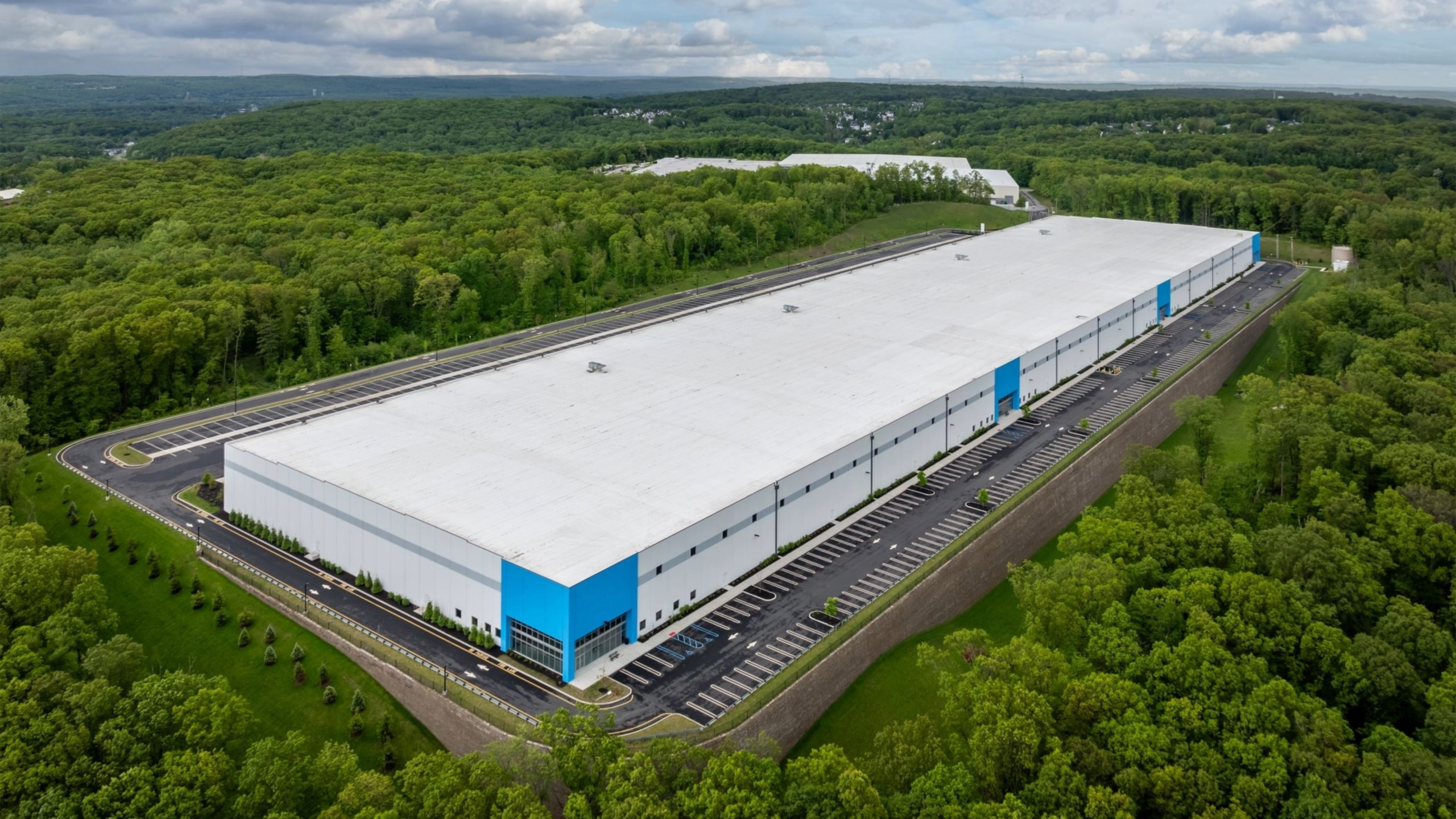
The federal government has now bought the Route 46 property that officials say will become an immigration detention facility, despite unanimous local opposition. The remaining questions are no longer whether the sale is real, but how much control Roxbury has left, what legal options remain, and what similar projects elsewhere suggest could follow.
MORRIS COUNTY, NJ – The federal government has completed its purchase of the 470,000-square-foot warehouse at 1879 Route 46 in Roxbury Township, confirming that the long-disputed site is no longer just a proposed target in the Trump administration’s detention expansion. Roxbury officials said the property was purchased directly from Dalfen Industrial and Goldman Sachs, and public records cited by multiple outlets show the U.S. Department of Homeland Security closed on the property on Feb. 19, 2026, for about $129.3 million.
That means the central question facing Roxbury has changed. Earlier this year, the debate focused on whether Immigration and Customs Enforcement was truly moving into Morris County. That much now appears settled. The harder questions are why the sale moved forward despite public opposition, what power local officials still have to slow or challenge the project, and what other communities’ experiences suggest a detention facility could mean for Roxbury if the site opens as planned.
The property was sold by DG Roxbury Property Owner LP, an ownership entity tied to Dalfen Industrial and a Goldman Sachs Asset Management fund. In public statements reported after the sale, Goldman Sachs said the warehouse had sat vacant for two years and that the firm had a “fiduciary obligation” to investors in the fund to sell it. Dalfen, which has described itself as a minority owner, said the property was sold to the federal government “in lieu of the potential of eminent domain” and that it would have no role in the site’s future use.
Local opposition, however, was already on the record before the sale closed. Roxbury officials created a public information page for the dispute, the township council passed Resolution 2026-029 opposing any ICE processing or detention use in local warehouses, and meeting records show residents were urging officials to take additional steps as early as January 13, 2026. The township’s resolution said a detention facility would place unanticipated demands on water, sewer, public safety and other municipal resources, and argued that warehouse areas were not intended for human occupancy.
This development places the Township in a challenging position under the Federal Supremacy Clause of the United States Constitution. As a result, local actions such as modifying ordinances or adopting a moratorium would not prevent the federal government from proceeding. – Statement read by Deputy Mayor Crowley, March 3, 2026
Even after that opposition, township officials have said the federal government’s legal position makes stopping the project difficult. In a March 3, 2026 statement, Roxbury said DHS had confirmed the purchase and that the township was in a “challenging position” under the Supremacy Clause, meaning local moves such as changing ordinances or adopting a moratorium would not necessarily stop the federal government from proceeding. The Associated Press has reported the same legal obstacle in communities around the country: federal projects are often not subject to local zoning rules when those local rules interfere with a federal mandate.
That legal imbalance helps explain why a vocal community can still lose a fight like this one. Roxbury can object, pass resolutions, and explore litigation, but once the federal government buys a site for a federal purpose, municipal leverage narrows sharply. The township has said it is still exploring legal avenues with the state, and Gov. Mikie Sherrill formally opposed the project in a Feb. 27 letter that cited concerns about transparency, infrastructure, environmental impacts, public safety, and detention conditions elsewhere. U.S. Sens. Andy Kim and Cory Booker have also backed legislation that would bar DHS from using federal funds to buy warehouses for detention conversion.
“ICE’s most recent reported purchase of a warehouse in Roxbury to use as a detention center is an affront to the Roxbury community who resoundingly rejected the prospect of a facility weeks ago. I joined them in this call, expressing my clear and unequivocal opposition to the construction, conversion, or opening of any more immigration detention centers in New Jersey. These facilities have no place in our communities.” – U.S. Senator Cory Booker (D-NJ)
The economic stakes for Roxbury are also part of the dispute. According to local officials’ estimates reported in public coverage, the federal acquisition could remove the property from the local tax rolls and cost Roxbury, Morris County, and the local school district about $1.8 million a year in tax revenue. That concern is not unique to New Jersey. In other states where ICE has moved on warehouse sites, local leaders have warned that federal ownership can shift costs onto surrounding taxpayers while reducing the property-tax base that funds schools, services, and local government.
“This facility would also siphon away what would otherwise be a viable economic opportunity for Roxbury and the entire State. New Jersey’s warehouse and distribution sector is a critical engine of economic growth, contributing nearly $300 billion annually in business activity and directly or indirectly supporting more than 1.35 million jobs in the state. The industry generates over $112 billion in personal income and more than $33 billion in tax revenue.” – Governor Mikie Sherrill in a February 27, 2026 letter.
What happens in communities after an ICE detention site opens has varied, but several patterns have emerged in other states now dealing with similar projects. One is secrecy or limited notice. AP has reported that at least 20 communities around the country became targets in ICE’s warehouse expansion with little advance communication from the federal government. Another is infrastructure strain. In Merrimack, New Hampshire, officials warned of tax-base losses and pressure on emergency services. In Social Circle, Georgia, local leaders raised concerns about sewage, water, public safety, and the loss of roughly $300,000 a year in property-tax revenue.
A separate, and more serious, question is what such facilities mean for the people held inside them. Roxbury’s site is not yet operating, and federal officials have said warehouse conversions would become “well structured detention facilities,” not simple industrial holding spaces. But critics point to conditions documented elsewhere in the detention system. A 2025 GAO report said DHS needed clearer goals and measures for assessing whether detention inspections are effective, while a recent AP investigation into ICE’s large Camp East Montana facility in Texas found frequent emergency calls, allegations of overcrowding, medical neglect, violence, and two deaths. Those examples do not prove the same outcome in Roxbury, but they help explain why detention standards, oversight, and operating details have become central to the debate.
For Morris County, the immediate reality is simpler and more concrete. The sale went through. The property has changed hands. Roxbury officials say they are still looking for ways to challenge or limit the project, but they have also acknowledged that local zoning alone will not stop a federal detention center if Washington decides to move forward. That leaves the next phase of this story centered on court action, state involvement, environmental review, infrastructure demands, and whether DHS publicly explains how a former warehouse on Route 46 would be converted into a site expected to hold up to 1,500 detainees.
At this point, the question is no longer whether ICE is coming to the Roxbury site. Based on the purchase records and official statements, it already has. The unanswered question is what kind of facility will be built there, what legal guardrails will apply, and how much of the cost, practical and civic, will fall on the surrounding community.