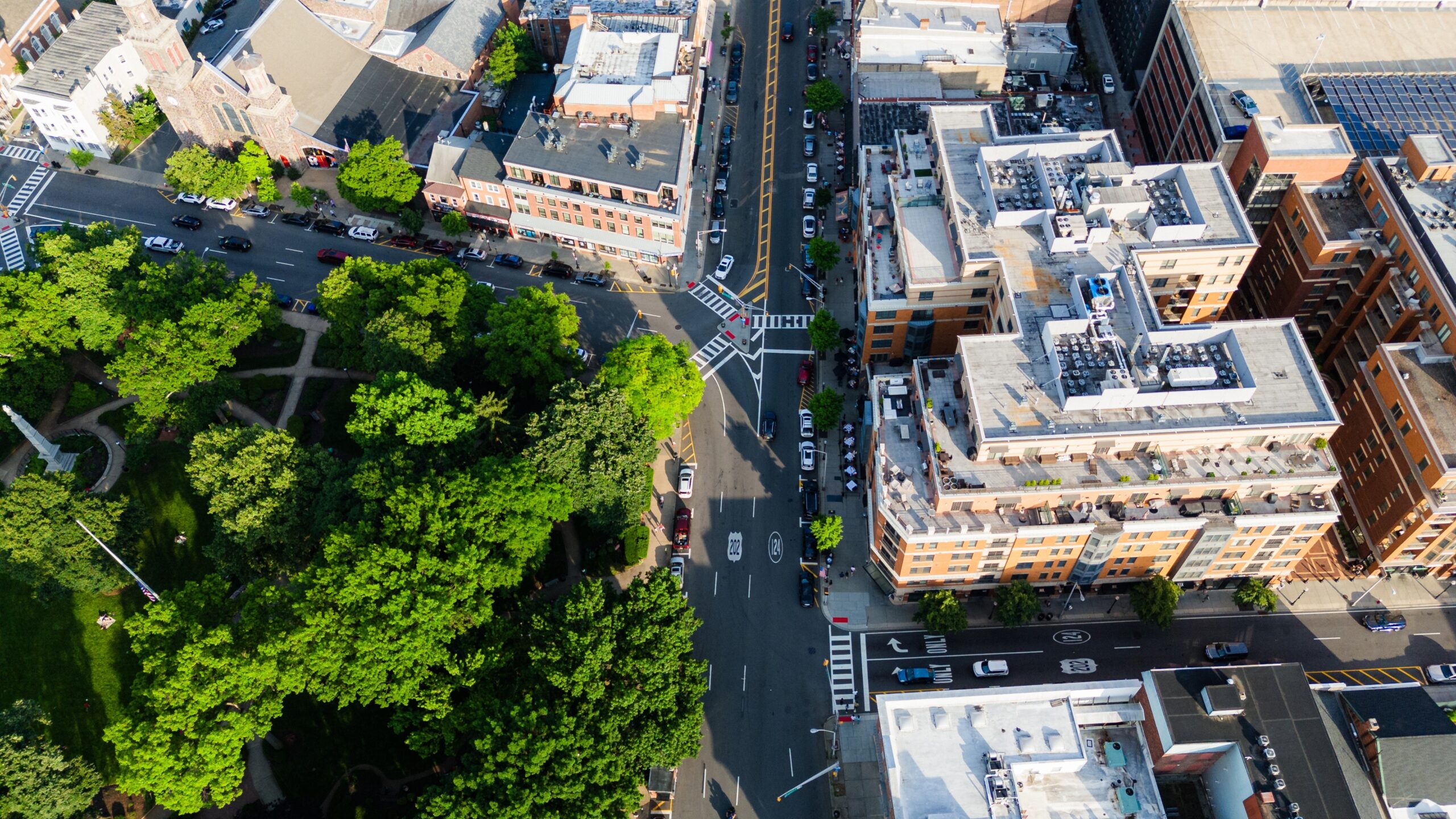
A long-running conflict between regional traffic demand and pedestrian safety is drawing new attention after a fatal Speedwell Place crash and years of planning data showing how much traffic moves through, rather than to, Morristown.
MORRISTOWN, NJ – A fatal March 20 crash at Sussex Avenue and Speedwell Place has renewed public attention on a problem Morristown has documented for years: a significant share of the vehicles moving through town are not beginning or ending their trips there.
The issue sits at the center of Morristown’s identity. The town is the seat of Morris County, a regional employment center, a transit hub, a courthouse destination and home to medical, commercial and government institutions that draw people from across northern New Jersey. It is also a dense, walkable community where residents cross the same streets that carry commuters, delivery trucks, county traffic and drivers trying to avoid peak-hour congestion.
Planning records show that tension is not new. A Complete Streets case study found that 40% of total vehicle traffic in Morristown was simply passing through town, while a separate 2017 Morristown Mobility Improvements presentation put pass-through traffic at roughly one-third of all town traffic. The mobility presentation also identified several long-standing challenges, including signal systems that were not fully responsive to peak-hour demand, historic streets with limited width and irregular geometry, and missing pedestrian links.
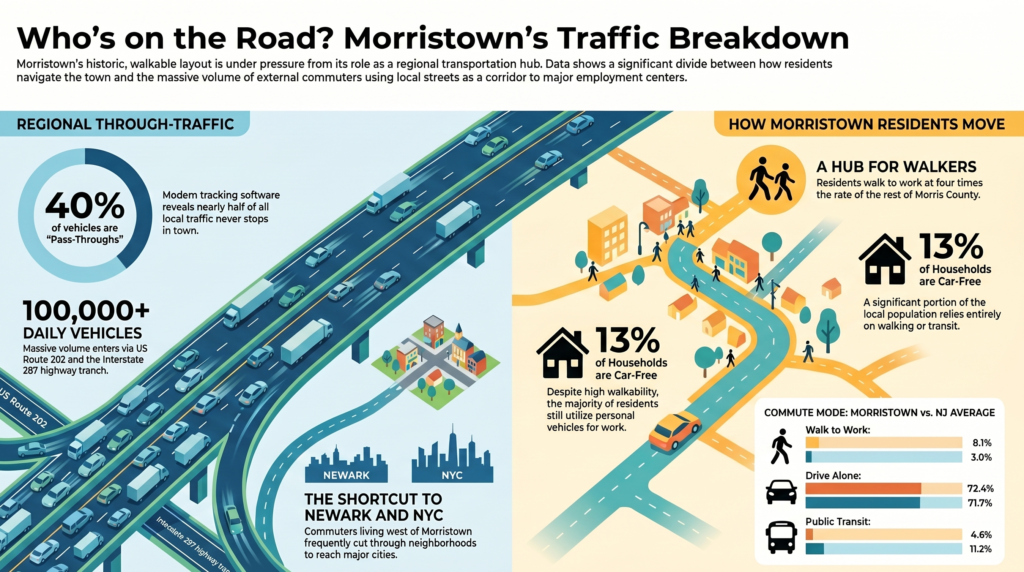
Those numbers help explain why traffic frustration in Morristown often becomes a pedestrian-safety debate. The same Complete Streets case study reported that 8.1% of Morristown residents walked to work, more than double the statewide share at the time. Census Reporter’s 2024 profile lists Morristown at 20,453 residents across about 2.9 square miles, with a population density of more than 7,000 people per square mile.
The recent crash gave that policy problem a human center. Justo Pillco-Tenesaca, 68, was struck in a crosswalk shortly before 7 a.m. on March 20 as a commercial truck turned right from Sussex Avenue onto Speedwell Place, according to authorities and local reporting. Prosecutors charged Wilson “Adrian” Morocho-Necta, 33, with leaving the scene of a fatal accident and endangering an injured victim. He is presumed innocent unless and until proven guilty in court.
At an April 14 Morristown Town Council meeting, residents pressed officials for stronger pedestrian protections after the crash, according to Morristown Green. Town officials said they were examining safety improvements across Morristown, including signal sequencing and the role of state and county-controlled traffic lights. Officials also pointed to a nearly completed pedestrian beacon at Hamilton Road and South Street, similar to one installed at Speedwell Avenue and Flagler Street in 2019.
Morristown’s own materials show pedestrian safety has been a recurring concern. In 2019, when the town launched its third Street Smart pedestrian-safety campaign, officials cited 74 pedestrian-involved crashes between 2015 and 2017. In 2017, the town said a pedestrian was struck every 15 days in Morristown, with 39% of pedestrian crashes attributed to drivers failing to yield and 34% occurring in marked crosswalks.
Street Smart combined education, outreach and high-visibility enforcement. Morristown also adopted a Complete Streets policy in 2012, directing the town to consider pedestrians, bicyclists, transit users, drivers, children, older residents and people with disabilities in transportation planning. But the policy challenge is larger than any one campaign. Complete Streets sets a framework; it does not, by itself, redesign intersections, change signal timing or determine how regional traffic should move through a town whose streets were not built for today’s volume.
That is where jurisdiction matters. Morristown can make local decisions, but many of the roads, signals and corridors that shape traffic flow involve county or state control. The town’s official economic profile says 22,000 workers and 106,000 drivers come into the area each day. That traffic is tied to Morristown’s regional function, including its downtown, train station, county government role and medical institutions.
The county has begun a broader safety-planning process. The Morris County Local Safety Action Plan, adopted by the Board of County Commissioners on Sept. 24, 2025, is intended to identify priority safety areas, potential improvements and grant opportunities through the federal Safe Streets and Roads for All program. County officials said the plan does not create specific projects by itself and that future work would require coordination with municipalities and public input. One Morristown location, Ann Street at Schuyler Place, was identified in county materials as one of the plan’s priority locations.
The local debate also fits into a statewide safety shift. New Jersey’s Target Zero law, signed in January 2025, set a goal of eliminating traffic deaths and serious injuries by 2040. The state’s action plan says New Jersey traffic fatalities rose 14% from 2023 to 2024, while pedestrian fatalities rose 32% during the same period. The plan also notes that pedestrians and bicyclists have made up roughly one-third of roadway fatalities in recent years.
For Morristown, the practical question is not whether regional traffic will continue to exist. It will. The county seat, courts, hospital, train station, offices, restaurants and downtown businesses all depend on access from outside town.
The question is how that traffic is managed once it enters streets where residents walk to school, work, shops, houses of worship, transit stops and municipal buildings.
Planning documents point toward several tools already under discussion or in use: updated signal sequencing, pedestrian hybrid beacons, better crossing connections, targeted enforcement, traffic-count analysis and a more coordinated approach between town, county and state agencies. Morris County conducts regular traffic counts on county roads, while the North Jersey Transportation Planning Authority monitors traffic statewide, giving officials a data source for identifying where volume, crash risk and pedestrian activity overlap.
That work would not remove Morristown’s regional role. It would define it more carefully. A county-seat town can serve commuters, workers, visitors and residents at the same time, but only if street design and traffic operations reflect the different risks each group carries.
Drivers passing through may experience congestion as delay. Pedestrians experience the same system as exposure. In Morristown, where a high share of residents walk and thousands of outside drivers enter the area each day, the difference is now central to the town’s transportation debate.
The next test is whether years of planning, crash data and community pressure turn into coordinated changes at the intersections where regional traffic and local life meet.
Excellent summary.
Forty percent of the vehicles on Morristown’s streets aren’t starting or ending their day here. They’re using the town as a corridor.
That changes what kind of problem this is. Signal timing, beacons, crossing redesigns — those are real tools, and Morristown has been working at them for years. But each one treats the symptom inside town limits. The underlying arrangement is that a regional system routes a third to nearly half of its volume through a 2.9-square-mile residential downtown, and the cost of that routing shows up as pedestrian exposure on local crosswalks. The drivers experience delay. The residents experience risk. Those are not the same currency.
So the question I keep landing on is less “how do we make Morristown’s streets safer” and more “who is supposed to pay for the safety cost of being a county seat?” Right now, most of the budget, the planning labor, and the political pressure sits with the town. The county and the state control many of the actual roads and signals where the conflicts happen. The Local Safety Action Plan is a real start, but a plan that “does not create specific projects by itself” is asking Morristown to keep doing the heavy lifting on a problem the town did not, by itself, create.
Curious whether the next step in this story is jurisdictional rather than design-based. Where does the cost of regional throughput actually get assigned, and what would it look like if it were assigned honestly?