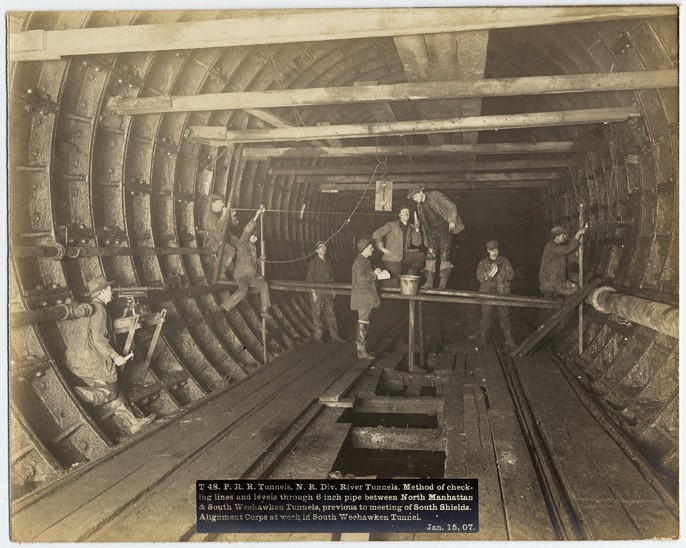
Gateway Hudson Tunnel Project moves forward with a major New Jersey contract expected in June, improving NJ Transit and Amtrak reliability and easing the Hudson River rail bottleneck.
The planned New Jersey Surface Alignment award would move forward the above-ground structures that connect existing Northeast Corridor tracks to the future Hudson River tunnel, a project tied to NJ Transit and Amtrak reliability for commuters across North Jersey.
MORRISTOWN, NJ – Gov. Mikie Sherrill announced May 1 that the Gateway Development Commission is expected in June to award the New Jersey Surface Alignment contract, the next major New Jersey-side construction phase of the Gateway Program’s Hudson Tunnel Project. The work would advance the above-ground approach between the existing Northeast Corridor in New Jersey and the entrance to the planned new Hudson River tunnel, including the visible raised alignment through the Meadowlands before the rail line goes underground near the Palisades.
The announcement matters for Morris County commuters because the Hudson River rail crossing is not only a Hudson County or New York City issue. NJ Transit’s Morristown Line includes daily trains operating between Dover and New York, via Morristown, according to New Jersey’s draft rail plan, and those trips ultimately depend on the same two-track Hudson River bottleneck used by Amtrak and other NJ Transit service into New York Penn Station.
Sherrill announced the expected contract award during remarks at the Regional Plan Association’s 2026 Assembly in New York. The state said the contract award by the Gateway Development Commission is anticipated next month.
“It’s the next major portion of work – two miles of raised tracks that run over the Meadowlands to the Palisades; the only part you’ll see before the tunnel disappears underground. That project alone will create thousands more good, union jobs. And I’ll always fight for those jobs – and for the Gateway workers I’ve been lucky to get to know.” Sherrill said.
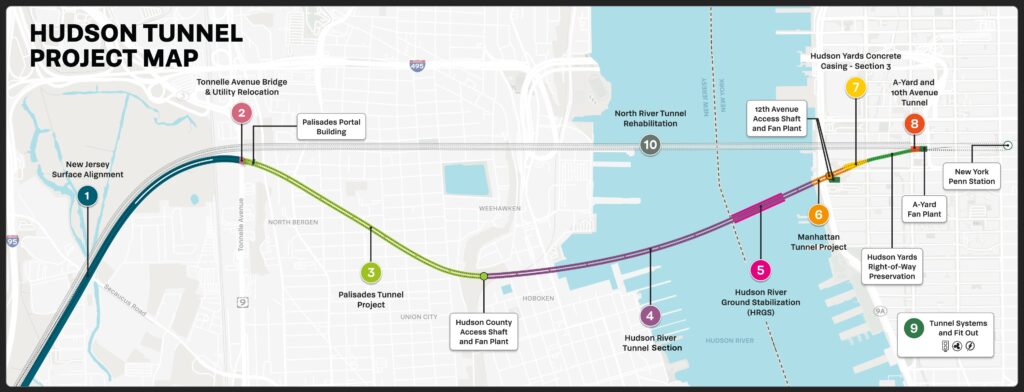
The New Jersey Surface Alignment is also known as Package 3 of the Hudson Tunnel Project. In procurement documents, the Gateway Development Commission described the package as about 7,540 feet of above-ground viaduct and berm trackway adjacent to the Northeast Corridor that would allow new tracks to connect the existing rail corridor to the entrance of the new Hudson Tunnel.
The package is not the same as installing the full rail system. Gateway’s procurement materials say the scope includes designing and building trackway infrastructure, including retaining walls, a new viaduct, bridges, an access road, and relocation of overhead electric, gas and communication lines. It does not include new railroad systems such as track and signals, which Gateway said would be awarded through future solicitations.
Four teams were shortlisted in February 2025 to compete for the design-build contract: George Harms Construction Co. Inc., Halmar International LLC, Skanska Creamer-Sanzari NJSA JV, and Walsh Ferreira JV. The winner, contract price and final notice-to-proceed timeline were not included in Sherrill’s May 1 announcement.
The expected June award would follow another major Gateway action. On April 27, the Gateway Development Commission awarded the Package 1C: Hudson River Tunnel Section contract to Traylor/Walsh/Skanska JV for $1.29 billion. That package covers the section of the new tunnel tubes beneath the Hudson River and includes two new tubes, each about 7,250 feet long, running from the Hudson County Access Shaft in Weehawken to the 12th Avenue Access Shaft on Manhattan’s West Side.
With the April award, Gateway said six of the 10 construction packages that make up the Hudson Tunnel Project are now completed or in progress, and contracts for all tunnel boring and construction of the new tunnel’s core and shell have been awarded or are underway.
The broader Hudson Tunnel Project is the centerpiece of the Gateway Program. Gateway describes it as a plan to build nine miles of new passenger rail track between New York and New Jersey, including nearly five miles of tunnel boring for a new two-tube Hudson River tunnel, and to rehabilitate the existing North River Tunnel, which entered service in 1910.
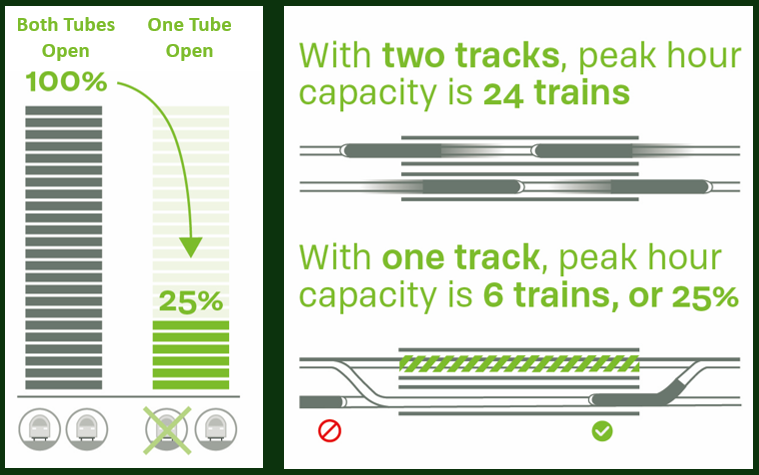
That existing tunnel remains the central vulnerability in the region’s rail system. Gateway says the North River Tunnel has two tubes, one carrying trains into New York and one carrying trains into New Jersey, meaning that a disruption in one tube affects service in both directions. The agency says Hurricane Sandy flooding in 2012 left chlorides that continue to damage the tunnel and its electrical equipment.
When finished, the Hudson Tunnel Project is intended to provide four modern tracks between New Jersey and New York instead of the current two-track constraint. Gateway says that would increase operational flexibility and redundancy for Amtrak and NJ Transit, while preserving service during rehabilitation of the existing North River Tunnel.
The corridor’s scale explains why the project has drawn federal, state and regional attention. Gateway says the 10-mile stretch between Newark, New Jersey, and New York Penn Station handles more than 200,000 passenger trips every day. Amtrak says the Gateway Program would create four mainline tracks between Newark and New York Penn Station and that the section serves about 450 daily trains carrying Amtrak and NJ Transit riders.
The project is also a large public financing effort. In July 2024, Gateway said it had secured the full $16 billion commitment needed to complete the Hudson Tunnel Project, including $12 billion in federal funding, a $6.88 billion Federal Transit Administration Full Funding Grant Agreement and $4.06 billion in federal Railroad Rehabilitation and Improvement Financing loans for the local share. Gateway said the new tunnel is expected to be in service by 2035, with full rehabilitation of the existing tunnel complete by 2038.
The June contract would also mark movement after a funding disruption earlier this year. Gateway said construction resumed the week of Feb. 24 after the commission received about $235 million from the federal government, restoring nearly 1,000 jobs affected by a construction pause that began Feb. 6. At that time, Gateway said the Hudson River Tunnel and New Jersey Surface Alignment contracts remained on hold while the commission sought access to federal grants and loans that had been paused since Oct. 1, 2025.
For Morristown and Morris County riders, the expected June award does not announce an immediate schedule change. Its significance is longer-term: the work would help connect the existing New Jersey rail network to the new tunnel system that Gateway says is needed to reduce dependence on the 115-year-old North River Tunnel and improve reliability for NJ Transit and Amtrak passengers.
The next formal step is the Gateway Development Commission’s expected contract award in June. Until that award is made, the winning contractor, final contract value and detailed construction schedule for the New Jersey Surface Alignment remain pending.