90% of Morris County’s automated license plate readers are supplied by Packetalk, in 2024 the county’s ALPR expansion was halted due to an FBI investigation into Packetalks owner and CEO.
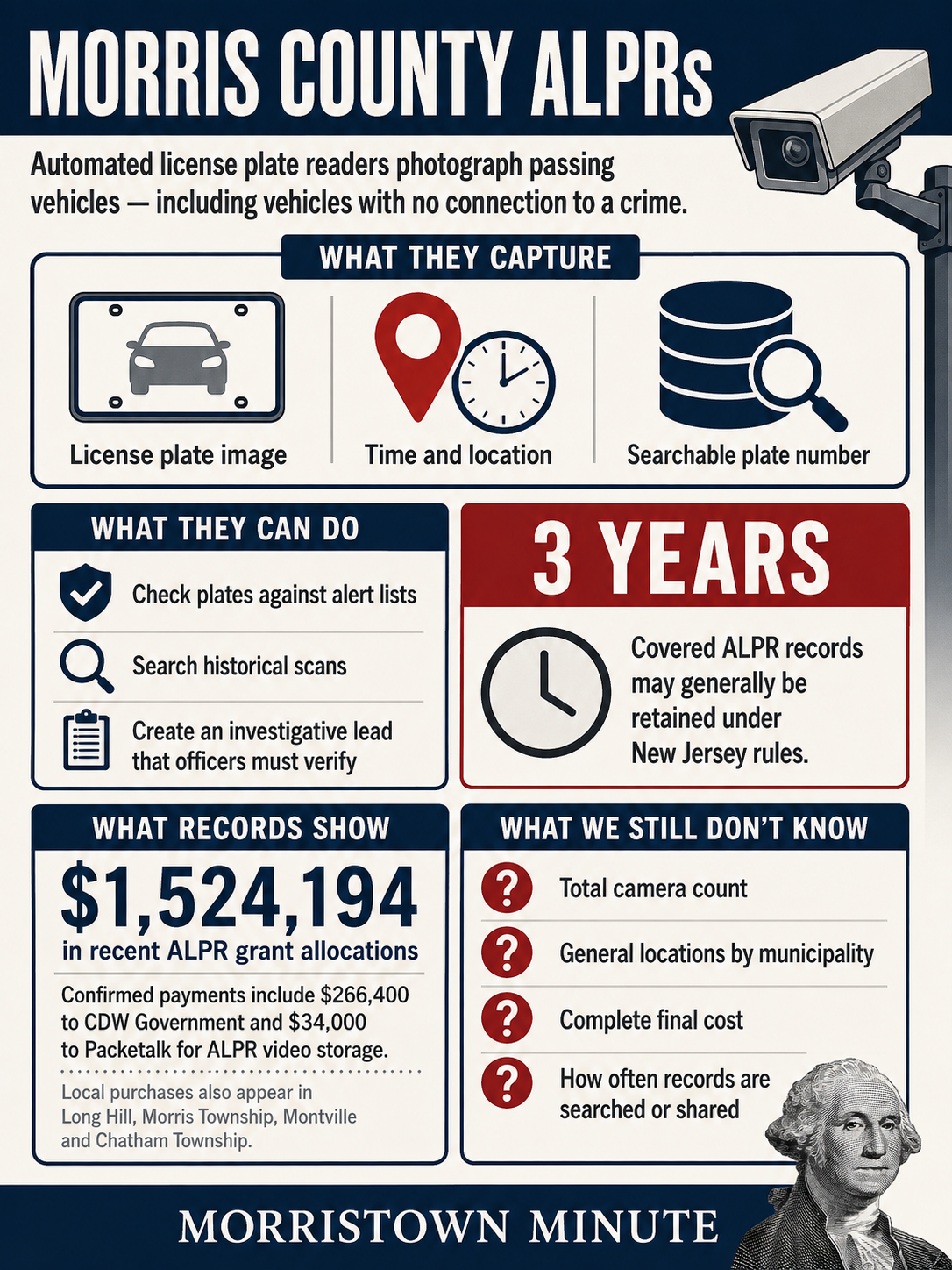
MORRISTOWN, NJ — When you drive past an automated license plate reader (ALPR) in Morris County, it photographs and captures a video of your license plate, vehicle, and the surrounding area, and records your plate number into a searchable format, attached to the time and location that photo or video was taken.
The captured information is then saved for a minimum of 3 years. After that time if the photo and video information captured is not related to any law enforcement investigation, that data is required to be deleted.
Morristown Minute’s month-long investigation into Morris County’s law enforcement surveillance infrastructure has revealed documentation for at least 279 ALPR cameras around Morris County. This is not a complete list of all cameras available. Records received by Morristown Minute from county and municipal law enforcement show that the county possesses a capacity for at least 600 cameras.
Of the verified 279 ALPR cameras, 251, about 90%, were supplied by the company Packetalk, a security systems supplier based in Lyndhurst, NJ. Packetalk sells automated license plate reader cameras, other surveillance cameras, video analytic software, wireless connections, and related equipment.
Why an FBI investigation revealed what the county’s dependence cost
In January of 2024, Morris County’s reliance on Packetalk for the supply and maintainence of the county’s ALPR technology became a problem when federal prosecutors charged Tamer Zakhary, Packetalk’s owner and chief executive officer, with wire fraud and making false statements following an FBI investigation.
Prosecutors alleged he misrepresented whether surveillance equipment sold to New Jersey agencies complied with federal restrictions on certain Chinese-made products. Those were allegations, not findings of guilt. Federal prosecutors dismissed the charges in June 2024; no conviction resulted from that case.
In a report to the U.S. Department of Justice, Morris County said it learned on Jan. 19, 2024, that Packetalk’s New Jersey vendor certification had been suspended as a result of the charges against Packetalk’s owner and CEO.
The county said the FBI investigation and charges “halted our progress toward achieving overall project goals.” The county said it was told on June 7 that the charges had been dropped and that Packetalk’s certification was reinstated later in 2024.
County officials considered switching providers and replacing Packetalk’s cameras and video-management system, but told the federal government that switching vendors would exceed their budget and might force them to spend expansion grants on replacement equipment, leaving towns to pay more or withdraw.
The federal expansion then faced a separate delay: approvals to mount equipment on state transportation property. In its latest report, updated Aug. 28, 2026, the county said it had issued Packetalk a purchase order but the grant-funded cameras were not yet installed and functioning. The report does not disclose their final number. The grant deadline has been extended to Nov. 30, 2026. That delay concerns new cameras; it does not mean the cameras already listed in the inventory are inactive.
What does an ALPR do?
Software reads a car’s license plate, using optimal character recognition to turn a photograph into a searchable log alongside the time and location. The automated system checks the plate number against police alert lists, which can include stolen vehicles and vehicles associated with missing people. A match can alert an officer.
A read that produces no alert is categorized the same way and stored for a minimum of three years. The same vehicle can be recorded multiple times via different cameras, so a count of reads is not a count of different cars or drivers.
For example, on January 1, 2022 the county’s ALPR camera recorded 56,993 “reads,” and on March 1, 2023, the county’s cameras recorded 190,140 reads. These are one day counts, 14 months apart, showing how much data these systems take in per day, and how fast the system has expanded.
So if you are driving around Morris County on any given day you’re license plate is likely being recorded multiple times by several different cameras cover different roadways and lanes. The 279 cameras confirmed by Morristown Minute’s investigation cover approximately 283 lanes of traffic.
The county says its system can collect more than a cropped picture of a plate. In an application for federal funding, it described 4K cameras capable of capturing an image of the vehicle and a short video. The application said software attempts to identify the vehicle’s type and color, its plate and possible vehicles following it, and captures an image or video of the surrounding area. The automated and AI-powered system can then track the movement of a vehicle by connecting separate sightings of a vehicle over time.
The amount of activity is substantial, although the latest daily total is unknown. On January 1, 2022, the county reported 56,993 reads in a single day. On March 1, 2023, 14 months later, the county reported 190,140 reads, a 233% increase in just over a year. The number of ALPR cameras has only increased over time, so it is reasonable to assume the number of license plate reads has increased exponentially as well.
How much does it cost?
Recent federal and state awards made $1,524,194 available for ALPR work: a $963,000 federal award for county expansion of 142 new ALPR camera, and $561,194 in state-announced 2023 allocations to the Prosecutor’s Office, Long Hill, Chatham Township and Dover.
The county records received by Morristown Minute document spending of $266,400 of the federal award on servers, storage and backup equipment, including a $34,000 Packetalk purchase for 144 terabytes of ALPR video storage.
On the municipal level, Morris Township paid Packetalk $45,000 in 2023 for seven stationary readers, installation and five years of maintenance. This purchasing example demonstrates the type of investments individual towns may make into ALPR infrastructure. Below you will find more examples of municipal cost of ALPR infrastructure, and while not a complete list (as the investigation is ongoing) the below table will give you an idea of what ALPR technology costs your town.
Below is a non-exhaustive list of payments made from municipal governments for Packetalk’s ALPR equipment.
| Municipality | When | What the record identifies | Amount and evidence |
|---|---|---|---|
| Montville | March 22, 2021 | Six fixed ALPR cameras, an optical character recognition license, installation and modems. | $50,000 authorized. |
| Montville | Dec. 31, 2021 | A second, separately funded package of six fixed ALPR cameras, a recognition license, installation and modems. | $48,800 authorized. |
| Madison | Feb. 14, 2022 | Packetalk security equipment and accessories for the police department; the resolution does not give a camera count. | Up to $25,000 authorized. |
| Dover | Aug. 23, 2022 | A Packetalk package quoted with four stationary ALPR cameras, modems, installation and five years of maintenance. | Up to $40,000 authorized. |
| Morris Township | Ordered Dec. 2022; paid April 19, 2023 | Two camera boxes containing seven stationary ALPR cameras in total, with modems, installation and five years of maintenance. The $52,000 quote carried a $7,000 discount. | $45,000 paid, according to the township purchase order’s check notation. |
| Long Hill | Approved June 21, 2023; on Dec. 11, 2024 bill list | Six installed ALPR cameras at township border locations. | $72,000, specified as $12,000 per installed camera in the approval; the later bill list records the same $72,000 Packetalk invoice. |
| Parsippany–Troy Hills | Check dated Nov. 16, 2023 | The check register describes the purchase as “ALPR”; it does not itemize cameras. | $174,200 check listed to Packetalk, PO 23-07313. |
| Chatham Township | Nov. 28, 2023 | Three Packetalk camera boxes combining PTZ infrared cameras and ALPR components, with installation, modems and one year of maintenance; procured through SHI. | $69,194.01 authorized. |
| Florham Park | Nov. 21, 2024 | Replacement cameras at Columbia Turnpike, Ridgedale Avenue, Hanover Road and Vreeland Avenue; the resolution does not give a camera count. | $68,900 authorized. |
| Mount Olive | April 1 and June 17, 2025 | ALPR cameras at various locations, followed by a proposed additional camera near Turkey Brook Park on Flanders Road. | $36,000 initially approved, then raised to $48,000 for the same contract. These are not two purchases to add together. |
| Chatham Township | April 22, 2025 | A direct Packetalk contract for ALPRs; quantity unspecified. | $24,000 authorized. |
| Florham Park | Aug. 14, 2025 | A Packetalk video surveillance camera system and related equipment; quantity unspecified. | Up to $50,000 authorized. |
| Chatham Township | Oct. 28, 2025 | Through CDW-G: a Packetalk box with one stationary ALPR camera and one PTZ camera, plus installation ($36,930), and a Packetalk network switch ($10,290). | $47,220 authorized in total. |
| Chatham Township | Nov. 10, 2025 | Through CDW-G: a Packetalk box with two stationary ALPR cameras and a 180-degree camera, enclosure and installation. | $27,902 authorized. |
| Montville | June 9, 2026 | Packetalk ALPR cameras through CDW-G; quantity unspecified. | $101,132 authorized. Montville canceled an earlier $99,202 order after a quote error, so the two figures must not be added. |
Status of Morristown Minute’s Investigation
We have dozens of OPRA and FOIA requests still pending. We have received thousands of pages of documentation concerning Automated License Plate Reader (ALPR) technology; information concerning costs of installation, hardware, software, training, maintenance, and violations. More information will be published as the records become roll in and the full picture becomes clear. We have been very careful in making claims about what technology the County and Municipalities possess and will always avoid speculation. There is a lot of misinformation, fear, anger, and irresponsible journalism surrounding ALPR technology. We will not play into that fervor. We will only report what we can confirm through primary source documentation.
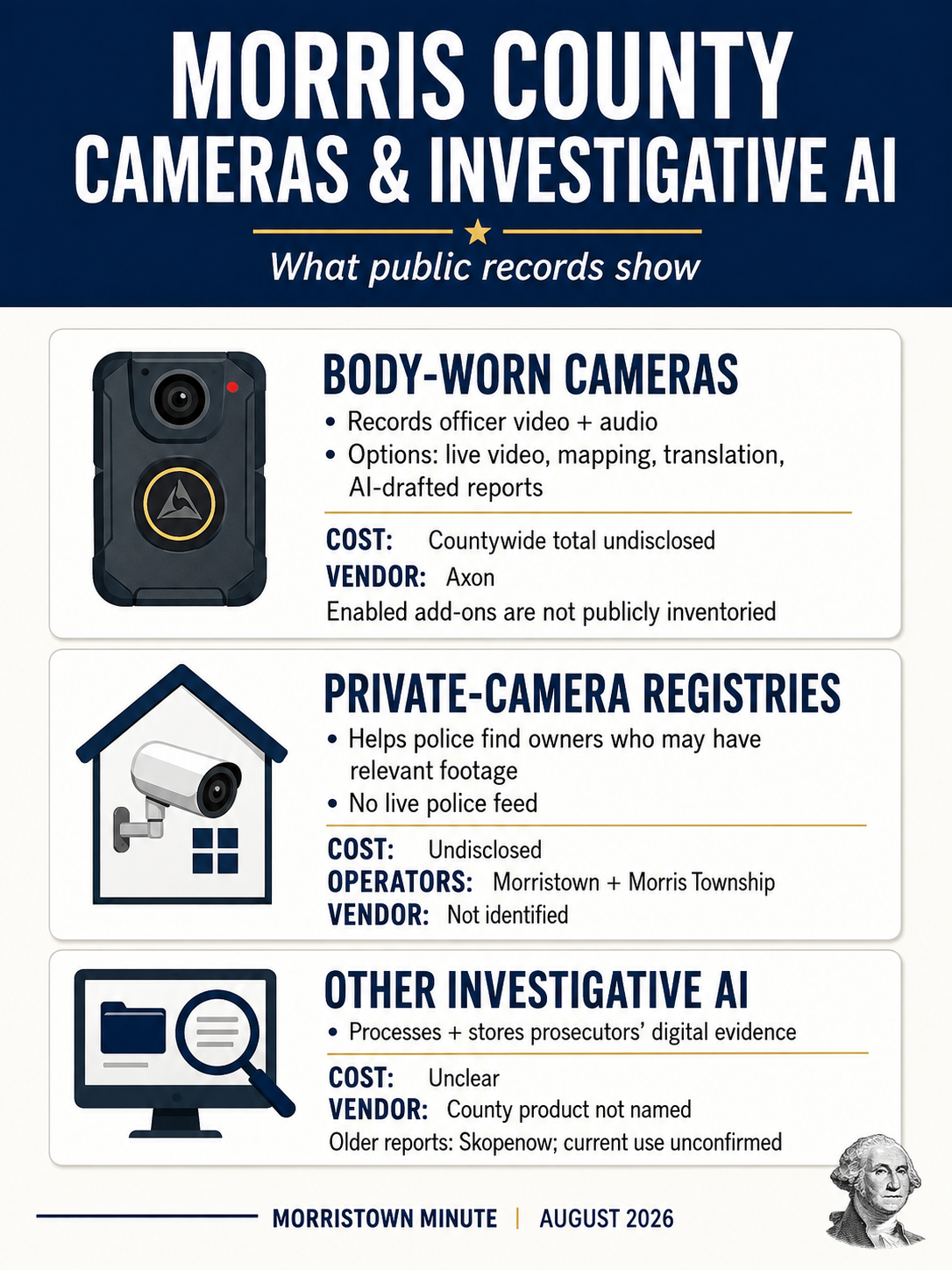
ALPR technology is only one subsection of our investigation. As referenced in our original article, Morris County possess several forms of law enforcement surveillance infrastructure, many of which is automated or AI-powered.
These include but are not limited to:
- Automated License Plate Readers.
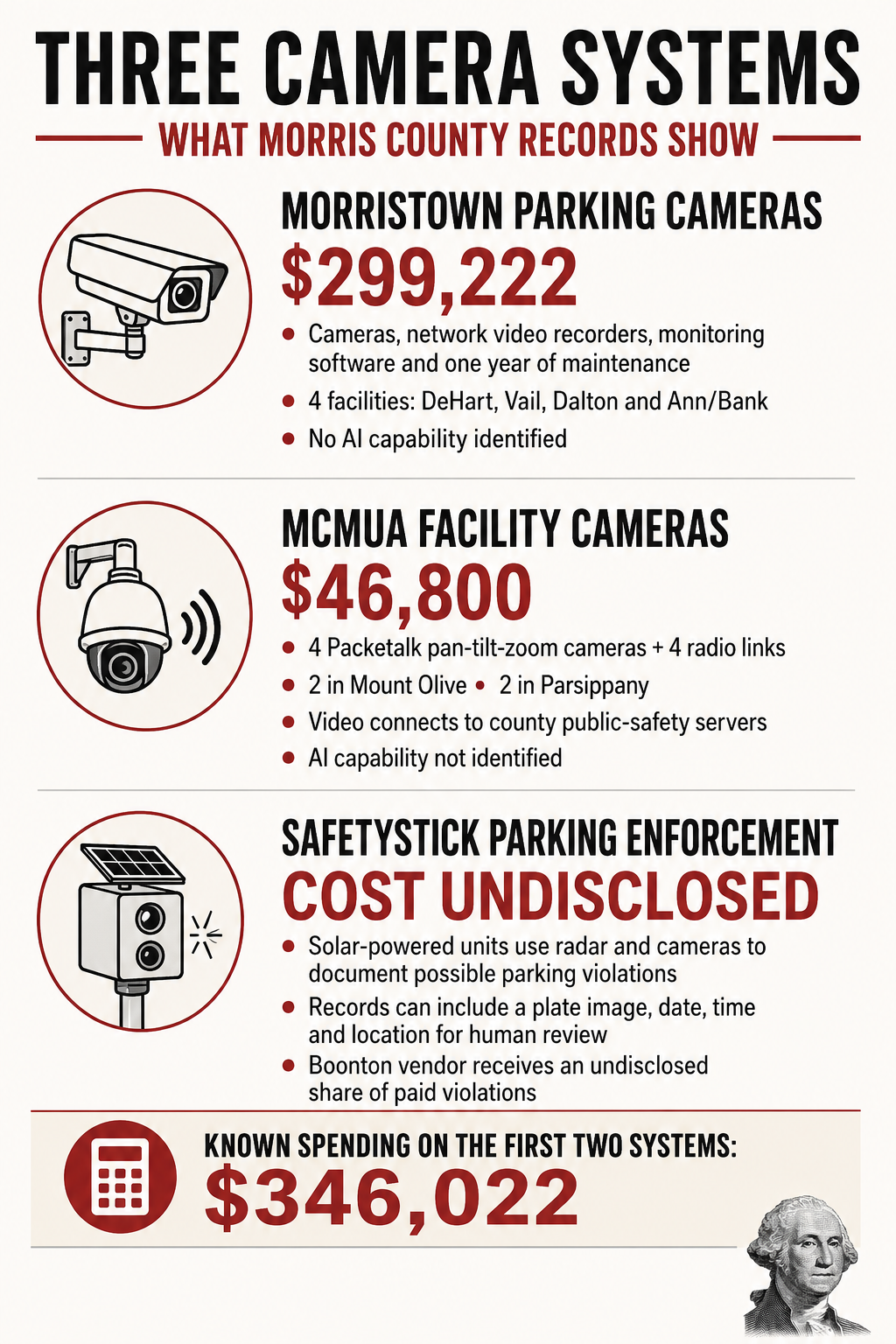
- AI-powered parking enforcement cameras (known as SafetySticks, though this is only one brand name).
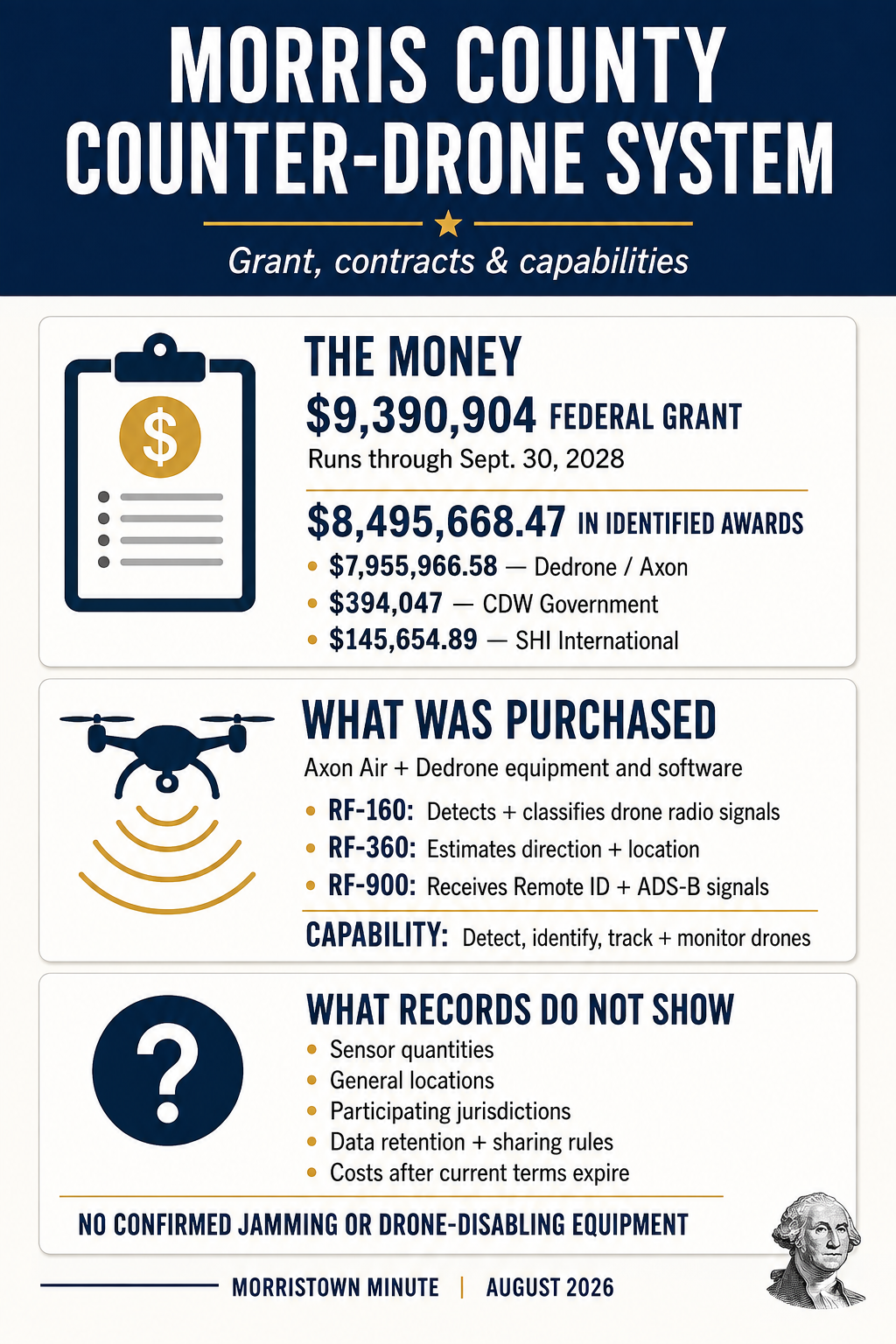
- Counter drone technology from Dedrone/Axon (with capabilities to tag, track and identify operators of drones) – we’ve identified at least $8,495,668.47 in contracts awarded to Dedrone.
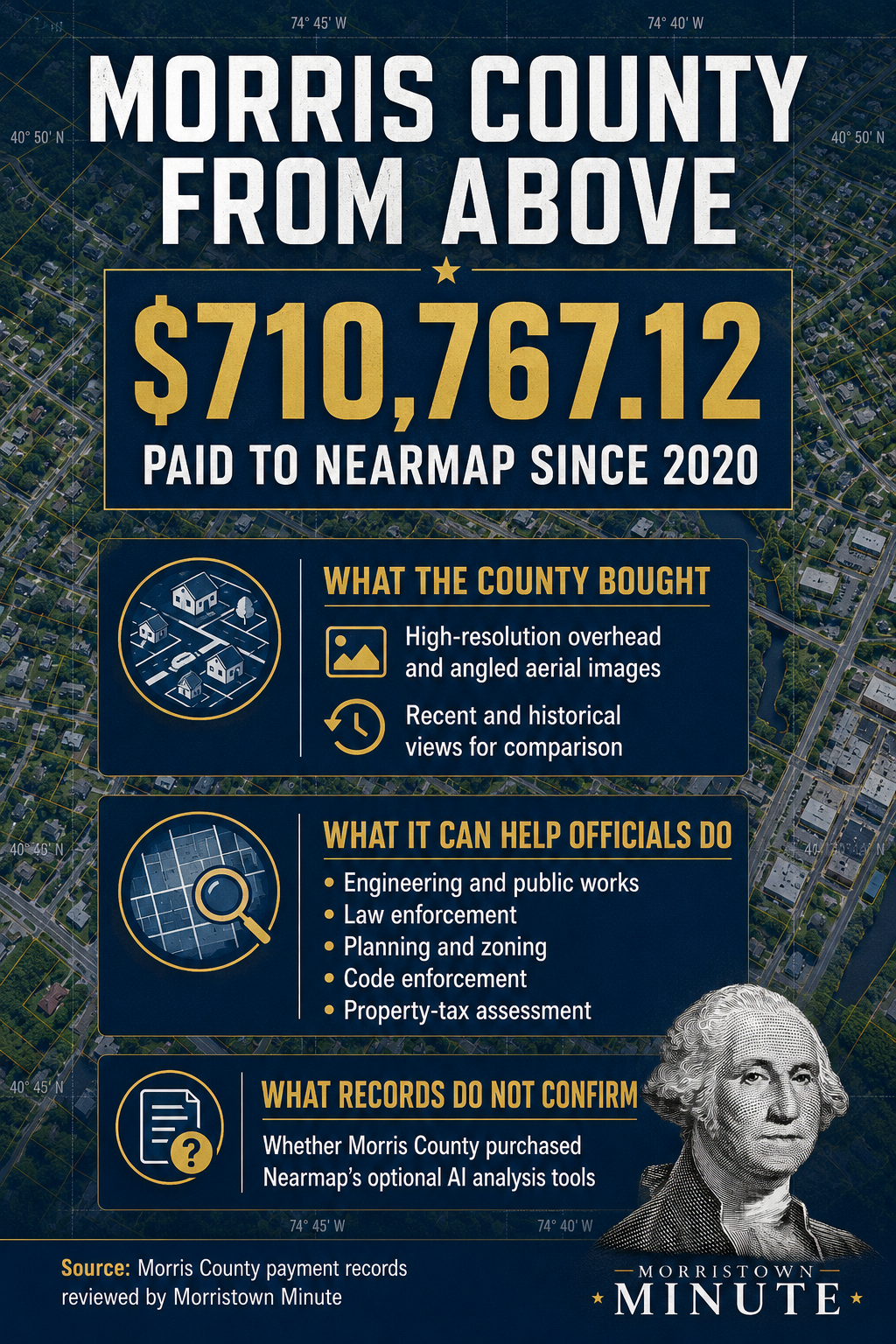
- Aerial imagery and mapping technology with AI-powered property analysis from Nearmap (allows municipalities to review property over time via a high-resolution aerial imagery service) – we’ve identified at least $710,767.12 in county payments to Nearmap.
- AI-powered dashcams intended for Morris County ambulances from Samsara through a national Sourcewell contract (full details such as exact costs still becoming clear).
- Body-worn cameras from Axon (Axon Body 4) that can livestream video, show users on a live map, send automatic alerts, upload recordings remotely, support two-way communication, activate recording wirelessly, translate conversations in real time, and auto-draft police reports (Draft One), all with AI-powered capabilities.
- Private Home Camera Registry that allows residents and businesses to opt-in to give law enforcement access to their private home cameras (registration does not give law enforcement a live feed).
- Skopenow, an investigative platform that searches and analyzes online content such as social media profiles, allowing law enforcement to gather information from across the internet and analyze relationships and produce investigative reports
You can learn more about all of these technologies by reader our initial article on our primary findings here.
As Morristown Minute receives more information we will update our readers on MorristownMinute.org with detailed articles, and on social media with segments of what we have learned.