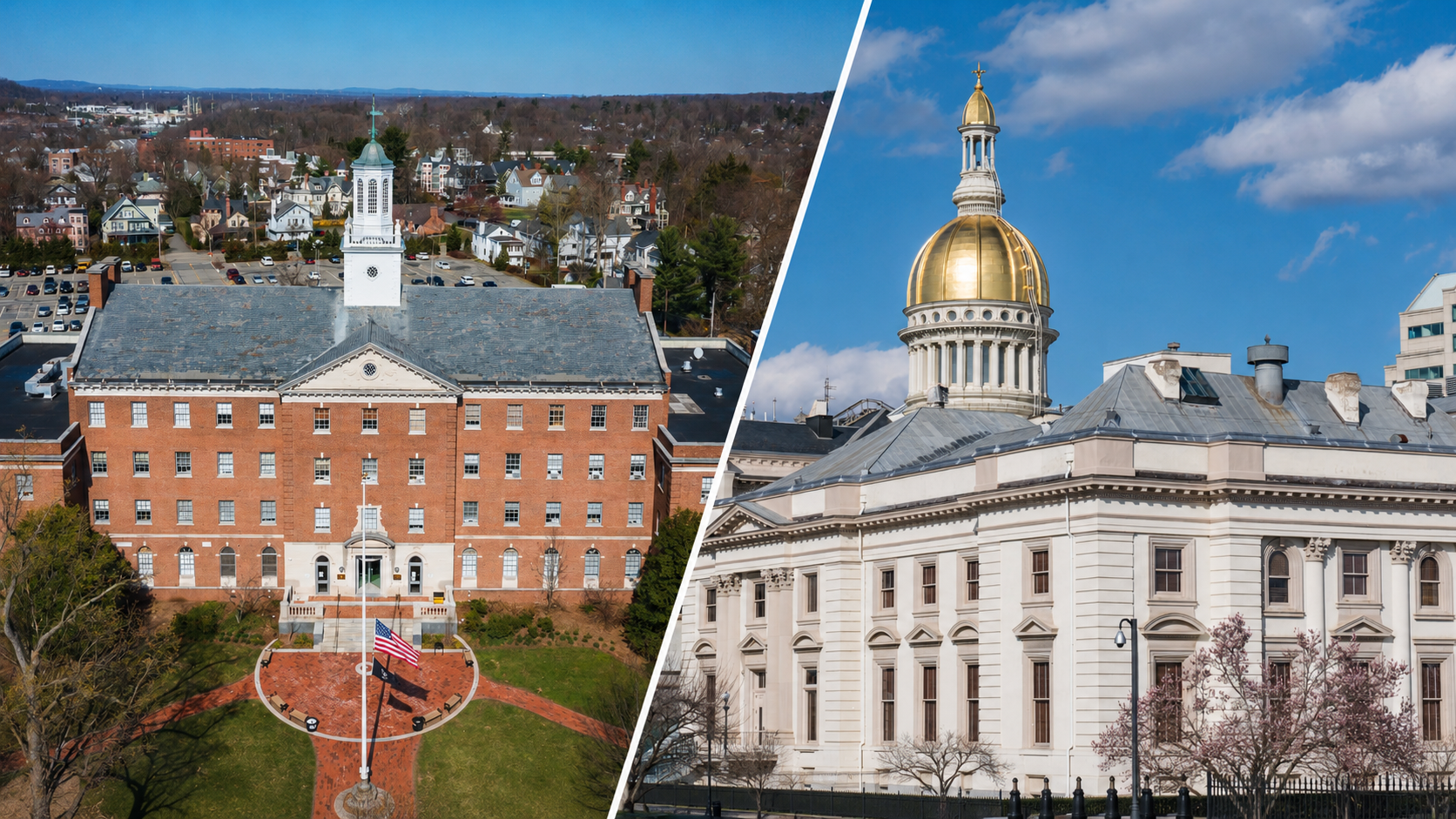
The state budget now heads to full legislative votes before July 1, with school aid, Medicaid, pensions, NJ Transit, municipal aid and direct property tax relief shaping what residents see in Morristown and Morris County.
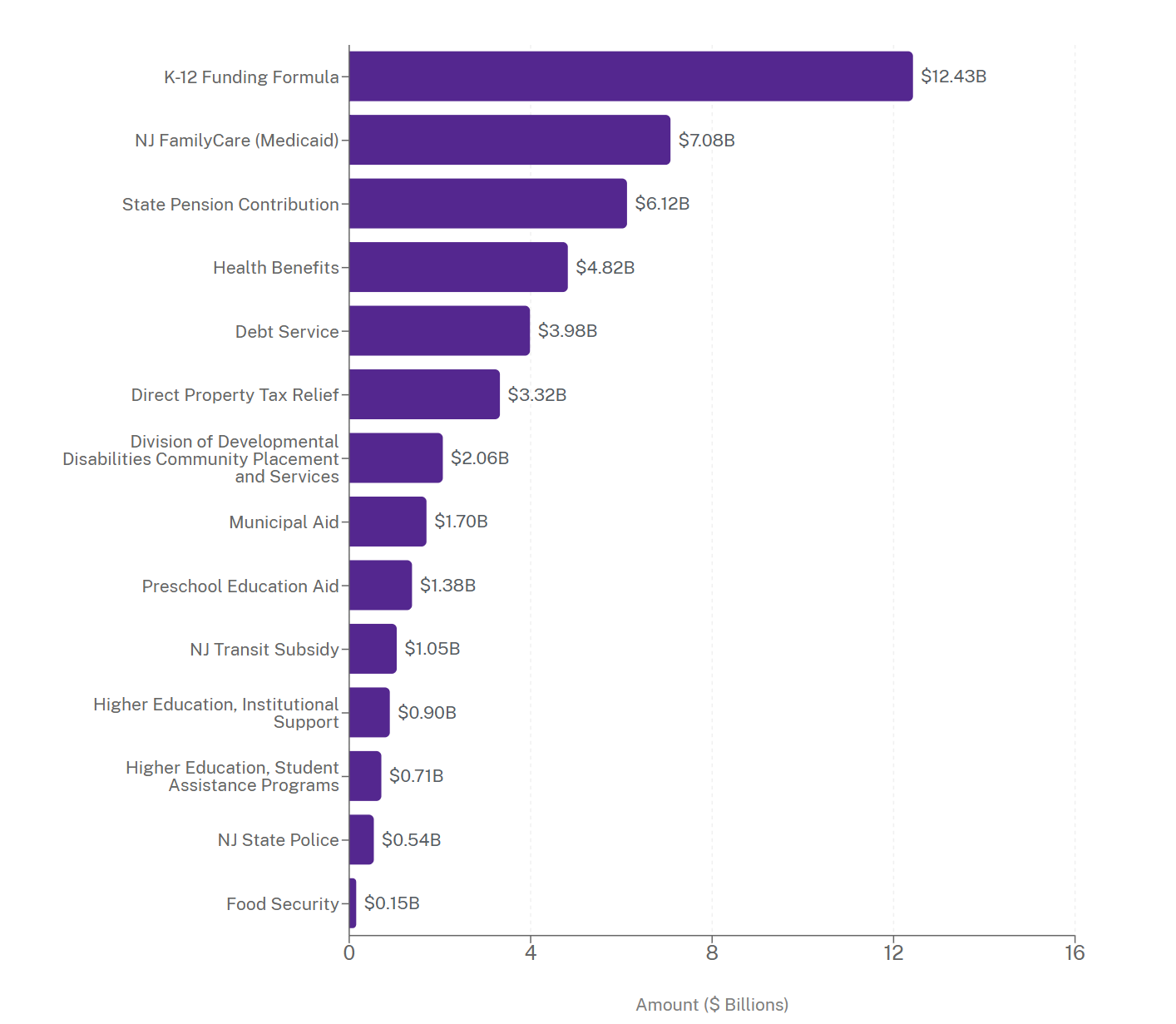
MORRISTOWN, NJ – New Jersey’s Senate and Assembly budget committees advanced a roughly $60.7 billion Fiscal Year 2027 state budget on Sunday, June 28, sending the spending plan to the full Legislature days before the state’s new fiscal year begins on July 1.
For residents in Morristown, Morris County and across New Jersey, the budget fight comes down to a practical question: how much of the cost of schools, health care, public pensions, transit, municipal aid and property tax relief will be carried by the state, and how much will continue to show up in local tax bills?
The committee version remains close to Gov. Mikie Sherrill’s original March budget proposal. The state’s New Jersey Report Card and legislative reporting put the plan at about $60.74 billion to $60.75 billion, compared with Sherrill’s original $60.73 billion proposal and a later revised proposal of $60.68 billion.
The budget is not final. It must still pass the full Senate and Assembly and be signed by the governor (expected June 30). If New Jersey does not have a budget in place before the new fiscal year begins, the state risks a government shutdown.
TLDR:
New Jersey budget committees advanced a roughly $60.7 billion FY 2027 budget just before the July 1 deadline, with major spending on schools, Medicaid, pensions, NJ Transit, municipal aid and property tax relief.

For Morristown and Morris County residents, the key issue is that even when the state funds billions in aid and relief, local costs for schools, municipal services, health benefits, pensions, infrastructure and transit still drive property tax bills higher.

Morristown’s 2026 budget shows this clearly: the average home is projected to see about a $52 monthly property tax increase, with schools accounting for the largest share.
The larger takeaway is that state budget decisions shape the pressure, but local tax bills show where that pressure lands.

See infographics below for more.
The largest question is affordability.
Sherrill and Democratic legislative leaders have framed the budget as a plan to protect property tax relief, fund schools, maintain pension payments and build a larger surplus. Republican budget members have criticized the process and argued that the budget does not distribute aid fairly enough among municipalities and school districts.
The disagreement matters locally because the state budget does not sit apart from municipal and school budgets. It helps determine school aid, municipal aid, NJ Transit funding, Medicaid costs, pension payments, infrastructure money and direct property tax relief. Those decisions affect the pressure on the local property tax base, even when the state budget itself is funded through income taxes, sales taxes, business taxes, fees and other revenue.
The state’s new New Jersey Report Card, a pilot website created to make budget information more public, is part of the story. It lets residents see where state money goes, how large program areas have changed over time, and how state spending is divided among departments, categories and programs.
The Report Card also shows the limits of statewide budget transparency. It can show that billions of dollars are going to schools, Medicaid, pensions and property tax relief. It does not, by itself, answer the local question many residents ask first: why is my property tax bill still going up?
Where the state money goes
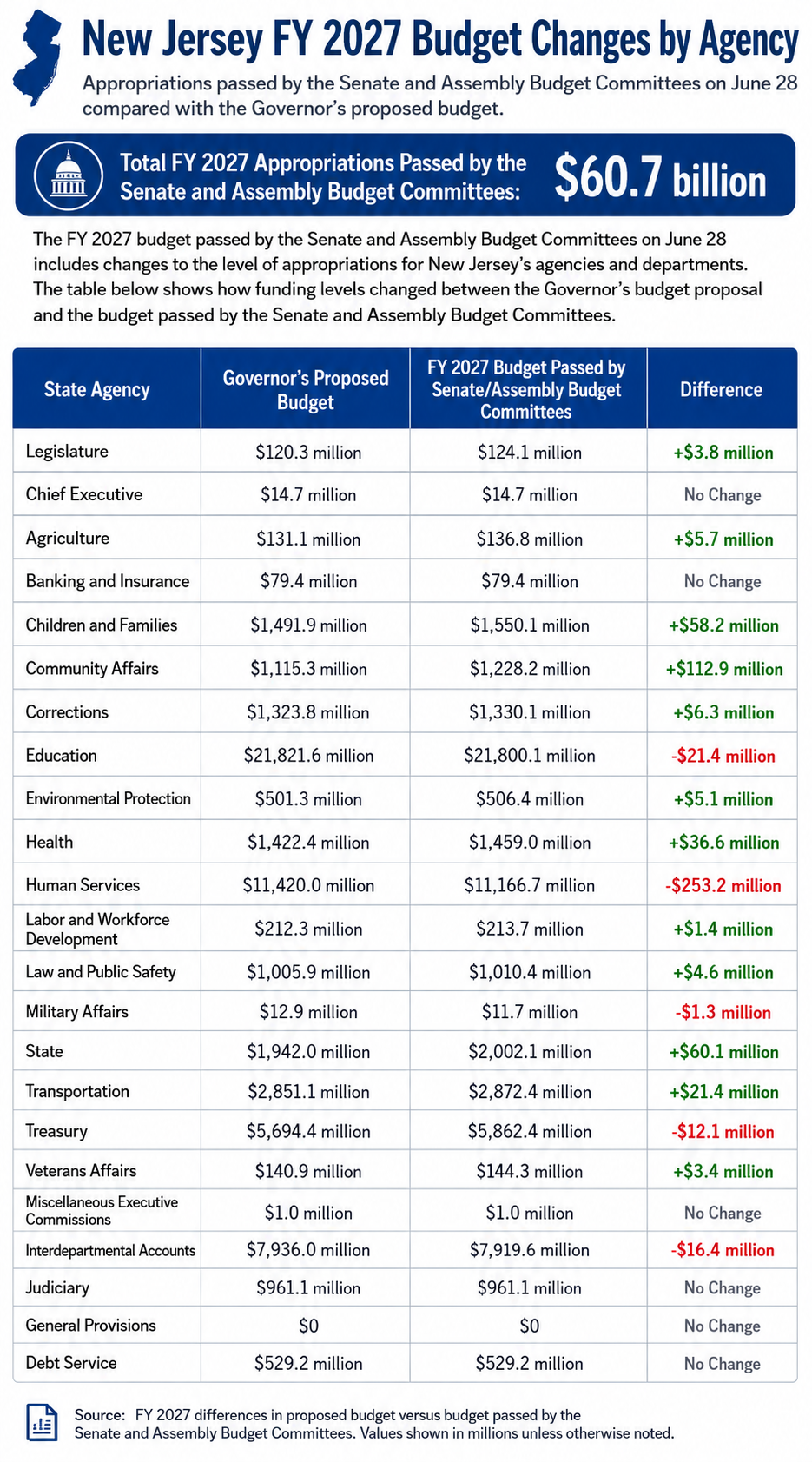
According to the state’s budget overview, the largest program areas in the FY 2027 proposal include $12.43 billion for K-12 formula aid, $7.08 billion for NJ FamilyCare, $6.12 billion for the state pension contribution, $4.82 billion for health benefits, $3.98 billion for debt service, and $3.32 billion for direct property tax relief.
Other major areas include $2.06 billion for Division of Developmental Disabilities community placement and services, $1.48 billion for municipal aid, $1.28 billion for preschool education aid, $1.07 billion for NJ Transit subsidy, and hundreds of millions of dollars for higher education, student assistance, the State Police, food security and other programs.
The state’s Budget in Brief describes the spending in broader categories. More than 40% of the state budget is distributed as state aid, including school aid and municipal aid. Another 34.3% is categorized as grants-in-aid, which includes services such as NJ FamilyCare and community-based supports for residents with disabilities. Debt service accounts for more than 5% of the budget, while executive operations, the direct cost of running state government, accounts for 8.9%.
The state expects revenues of about $59.1 billion to support the budget. Its major revenue sources include the gross income tax, sales tax, business taxes, the corporate transit fee, petroleum products tax revenue, casino-related revenue and other taxes, fees and transfers.
The gross income tax is especially important because New Jersey’s Constitution dedicates that money to property tax relief. In practice, that can mean direct relief to residents, aid to school districts, aid to municipalities, or other programs designed to offset local costs.
Property tax relief is a major part of the budget, but it works in different ways.
The administration says the FY 2027 budget includes $28.7 billion in direct and indirect property tax relief, including school aid, municipal aid, direct relief programs and other local aid.
Direct relief programs include ANCHOR, Senior Freeze, Stay NJ, property tax deductions and related benefits. The governor’s proposal included about $4.2 billion in direct property tax relief programs and tax deductions. The budget also modifies Stay NJ by setting the income threshold at $250,000 and capping the maximum benefit at $4,000, according to the Budget in Brief.
That distinction is important. Direct property tax relief can help residents after taxes are billed. School aid and municipal aid can reduce the amount local governments and districts need to raise from property taxpayers. Both are called property tax relief, but they reach residents differently.
A rebate does not lower a town’s operating costs. A school aid increase can help a district budget, but it may not prevent a local tax increase if health benefits, salaries, special education, transportation or building costs rise faster. Municipal aid helps towns, but if that aid is flat while expenses rise, the property tax levy can still increase.
Morristown shows how state and local budgets meet.
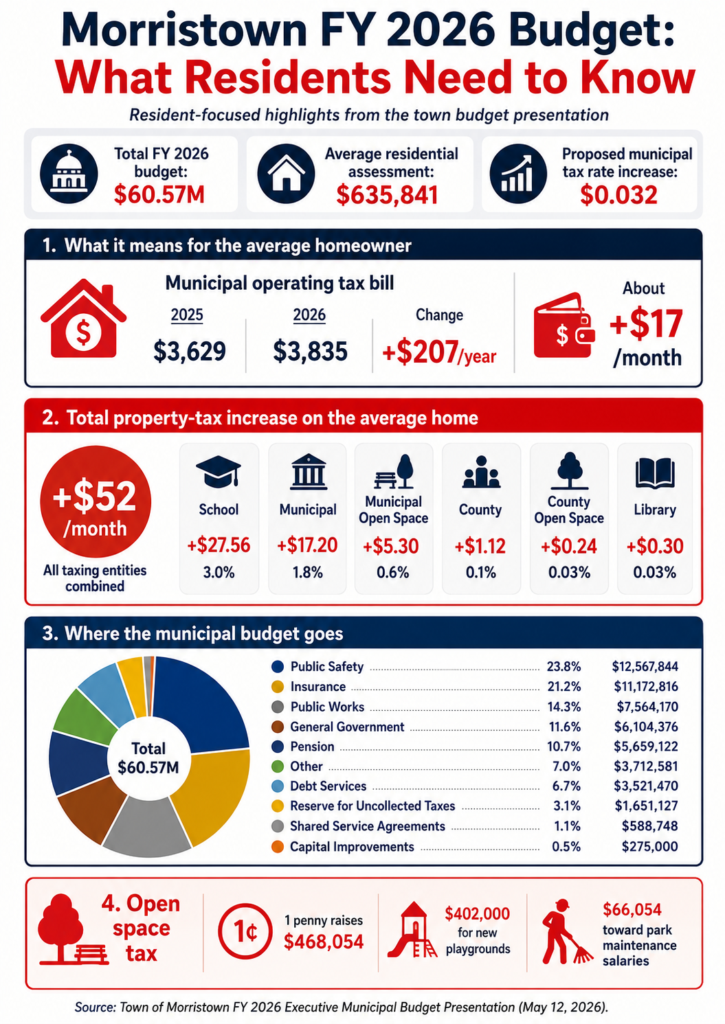
Morristown adopted a $60.57 million 2026 municipal budget on June 9, according to the town’s budget presentation. The town estimated that the municipal operating portion of the tax bill would increase by about $207 per year, or $17.20 per month, for a home assessed at the town average of $635,841.
The full estimated property tax increase for that average home was about $52 per month, because the local tax bill includes more than municipal government. The Morris School District accounted for the largest portion of the projected increase, about $27.56 per month. The municipal operating budget accounted for $17.20, municipal open space for $5.30, county government for $1.12, county open space for 24 cents, and the library for 30 cents.
Morristown’s budget presentation showed the school district accounting for about 51.5% of the total property tax bill, municipal government for 32.5%, county government for 13.4%, and the library for 2%.
That means many residents experience “property taxes” as one bill, even though the money is divided among several governments. State decisions affect each part differently.
For Morristown municipal government, the budget presentation showed the town relying on the municipal tax levy for 56.8% of 2026 revenues. State aid accounted for 5.5%, while state and federal grants accounted for 0.2%. The town also relies on surplus, local revenues, sewer utility surplus, special items, delinquent tax receipts and Uniform Construction Code revenue.
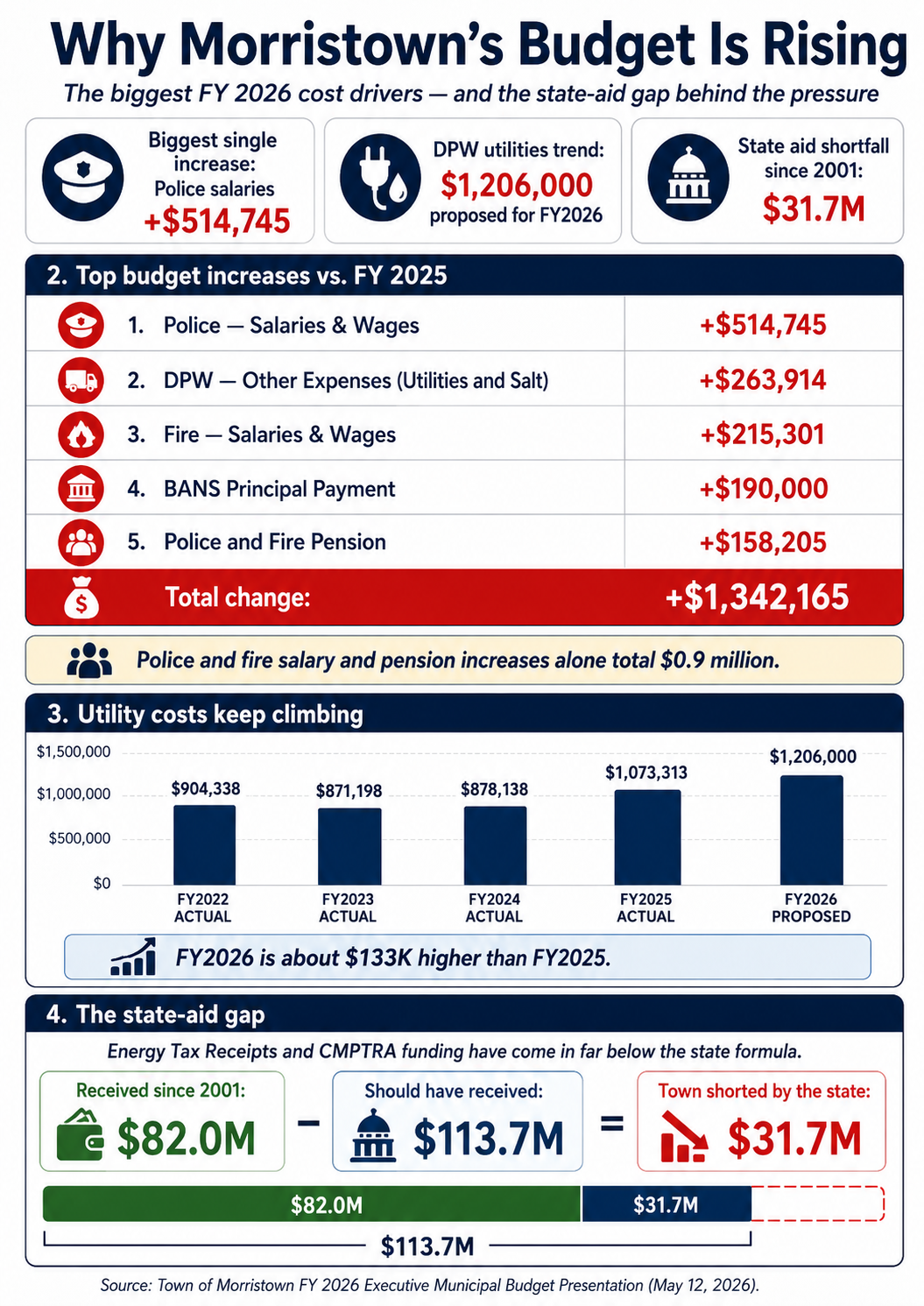
The town’s presentation identified public safety, insurance, public works, general government and pensions as major cost areas. Public safety accounted for 23.8% of proposed appropriations, insurance for 21.2%, public works for 14.3%, general government for 11.6%, and pensions for 10.7%.
The local cost drivers are familiar across New Jersey: salaries, health insurance, pensions, utilities, fuel, debt service, roads, public safety, public works and aging infrastructure.
Morristown also pointed to a long-running state aid issue. The town’s budget presentation said the state has shorted Morristown $31.7 million since 2001 in Energy Tax Receipts and Consolidated Municipal Property Tax Relief Aid, known as CMPTRA. The town said it has received $82 million since 2001, compared with $113.7 million it says it should have received under the formula.
That local claim reflects a broader dispute between municipalities and the state over energy tax receipts and municipal aid. Municipal officials have long argued that money collected by the state from utilities was intended to support local property tax relief. State budgets have often used portions of that revenue differently, leaving towns to argue that state-level decisions put more pressure on the property tax levy.
Schools are the largest local pressure point.
For Morristown residents, school funding is the largest part of the property tax bill. That makes state education aid one of the most important local pieces of the state budget.
The FY 2027 state aid notice for the Morris School District shows $10,307,696 in K-12 state aid, a decrease of $21,795, or 0.21%, from FY 2026. The district serves students from Morristown and Morris Township, with Morris Plains sending high school students to Morristown High School through a sending-receiving relationship.
The district approved a $155.7 million 2026-27 budget with a tax levy of about $111.4 million, according to local reporting and district materials. The school tax levy rose more than 2% because the state allows certain adjustments, including health benefit cost increases.
The district is also preparing a $158 million bond referendum scheduled for Sept. 15, 2026, to address infrastructure needs at 10 schools. The district says the New Jersey Department of Education reviews proposed projects and determines state aid, and voter approval is required to access that aid.
This is another way the state budget becomes local. A statewide school construction or debt-service policy can affect whether local taxpayers pay the full cost of school repairs, or whether the state reimburses a portion.
Morris County has held its tax rate steady, but state aid and grants still matter.
Morris County adopted a $407.3 million 2026 budget in March. County officials said that figure was inflated by the early authorization of $24.3 million in grant funding, bringing the adjusted budget to about $383 million. The county said the early grant authorization did not affect the county tax levy.
The county also said it maintained no increase in the county tax rate for a seventh consecutive year. Its budget presentation listed a county tax rate of $0.218, down from $0.232 in 2025, and said the budget was structurally balanced and cap compliant.
County government sits between the state and municipalities. Morris County is responsible for services that are either mandated by the state or are more efficiently handled at the county level. Those include court facilities, law enforcement and jail operations, welfare and human services, education-related functions, roads and bridges, elections, parks, the county library, paratransit, mosquito control, veteran services, job training and other programs.
The county’s major source of revenue is the county property tax. State and federal grants also fund programs the county administers. When the state changes funding for social services, transportation, public health, courts, elections or infrastructure, county budgets can feel the effect.
That is why the state’s decision to fund Medicaid administration, food assistance, transportation reimbursements, social services and grants does not stay in Trenton. It can determine how much county government can absorb without shifting more cost to property taxpayers.
NJ Transit is a local budget issue for Morristown commuters.
The state budget includes more than $1 billion in state operating support for NJ Transit, including a General Fund subsidy and dedicated revenue from the Corporate Transit Fee. The budget also includes about $782 million for NJ Transit capital projects as part of the State Transportation Capital Program.
For Morristown residents, this matters through the Morris & Essex Lines and the broader commuter network. Rail service, fares, reliability, capital maintenance, station conditions and bus connections all depend on NJ Transit’s operating and capital budgets.
State transit funding can reduce pressure for fare hikes or service reductions, but it also depends on dedicated revenues, federal support, capital needs and system-wide labor and maintenance costs. The budget does not settle those questions permanently. It funds another year of operations and capital work.
The Report Card makes the budget easier to see, but local impact still requires another layer.
Check out the New Jersey Report Card, it’s useful because it lets residents see the budget by department, program and revenue source.
The Budget Overview page shows how large the current proposal is, what changed between the governor’s proposal and the committee version, and which programs receive the most money.
The Looking Back page adds context by showing how appropriations have changed over time. Education and Human Services remain the largest state departments by appropriation. The page also shows how state spending categories, such as direct state services and grants-in-aid, have grown over the past decade.
That historical view is important because the current budget fight did not begin this year. New Jersey’s budget has long been shaped by pension obligations, health benefit costs, school funding formulas, Medicaid growth, transportation needs, debt service, local aid disputes and property tax relief programs.
The Report Card also shows why residents need local context. State aid may be rising statewide while one district gets a small cut. Direct property tax relief may increase while a municipal tax levy still rises. NJ Transit may receive more state support while commuters still face delays. A county may hold its tax rate steady while towns and school districts increase their levies.
State budget numbers explain the system. Local budgets explain the bill.
What residents should watch next
The immediate next step is the full Senate and Assembly vote. After that, the governor can sign the budget, veto specific line items, or take other action allowed under state law.
For Morristown and Morris County residents, the most important items to watch are the final levels for school aid, municipal aid, NJ Transit support, property tax relief programs, health benefits, pension payments, infrastructure grants and any local spending additions included in the final appropriations act.
The larger question will remain after the budget is signed. New Jersey is using the state budget to fund direct relief, support local governments and pay large fixed obligations. Local governments and school districts are still facing rising costs for labor, health care, pensions, utilities, transportation, facilities and public services.
That is the budget fight in plain terms. The state can move money toward relief, aid and services. Local governments still have to balance their own budgets. Residents see the result in school taxes, municipal taxes, county taxes, train fares, health programs, public services and rebate checks.
The state budget decides where billions go. The local tax bill shows where the pressure lands.