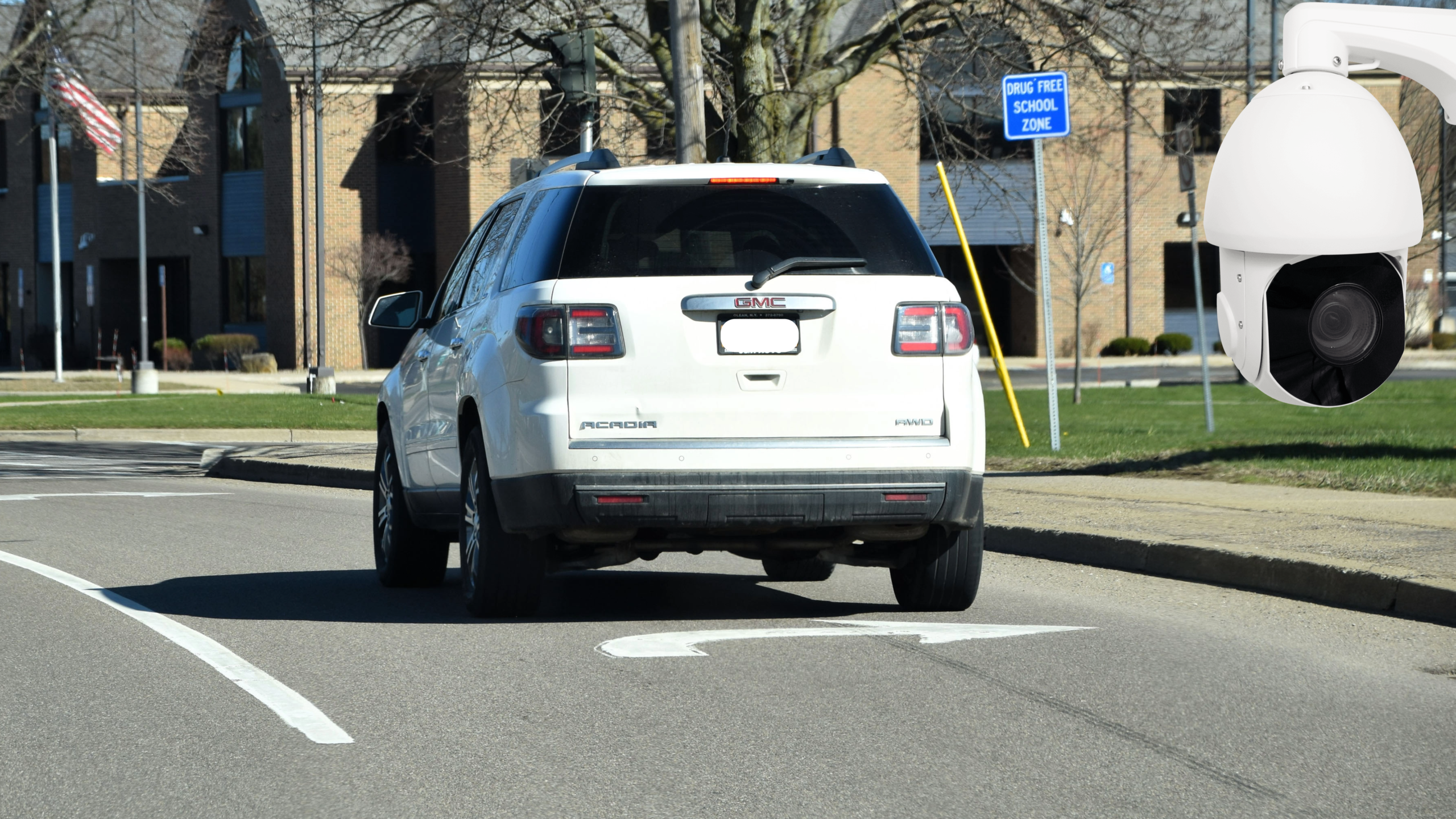
Search logs show officers can query Morris County’s license plate readers by describing a car, with no plate number at all.
MORRISTOWN, NJ — On Friday, Aug. 15, 2025, a Lincoln Park police officer searched for every white GMC Acadia that passed a license plate reader in five North Jersey counties over a six-hour stretch. The search returned 609 records. The officer logged the reason as a motor vehicle violation.
That search comes from Lincoln Park’s own police search logs, which the borough released to Morristown Minute through a public records request. It shows something most drivers don’t know about license plate readers: police don’t need your plate number to find your car. They can describe it.
In 2024, nearly three in 10 searches Lincoln Park officers ran used no plate number or only part of one.
How a description search works
A license plate reader photographs every car that passes and turns the plate into a searchable record tied to a time and place. But it records more than the plate. In its application for a federal grant, Morris County said its cameras use “4K cameras and Artificial Intelligence” to identify “the type of vehicle, color of vehicle, license plate, and any potential follow vehicles.” A data-sharing agreement between Flock Safety and Mount Olive’s police department lists “vehicle description” among the data Flock’s cameras capture.
That’s what makes a description search possible. A plate search asks where one car went. A description search asks which cars looked like this one. It works like a phone book: a plate search looks up one name, and a description search asks for everyone named Smith.
Description searches have an obvious use. A witness often remembers a car’s color and model but not its plate. The Aug. 15 search followed that pattern. Before searching for the Acadia, the officer tried four versions of a partial plate, each with different characters missing, and then searched for any white GMC compact SUV, which returned nothing.
The officer set the Acadia search to cover Bergen, Essex, Hudson, Morris and Passaic counties. Axon cameras returned 185 records, Vigilant returned 174 and Packetalk returned 158. Three smaller networks returned the rest.
A single car can show up more than once if it passes several cameras, so 609 records doesn’t mean 609 different cars. But the officer was looking for one car. Everyone else in those results was just driving a white Acadia that Friday.
How often it happens
Morristown Minute counted every search in Lincoln Park’s logs for 2024 and 2025, treating each distinct set of search terms as one search.
In 2024, officers ran 99 searches. Twenty-one used no plate at all, only a description, such as a make and color. Eight more used a partial plate. Theft was the most common reason officers gave for description searches, at 12 of the 21.
In 2025, officers ran 50 searches. Two used only a description and six used a partial plate.
Partial-plate searches can be just as broad. On Dec. 31, 2024, an officer working a motor vehicle violation searched for a plate made of one letter and two wildcard characters across a two-and-a-half-hour window. It returned 1,377 records. The same officer also searched for a red Buell sport motorcycle with no plate number. That search returned nothing.
What the rules say
New Jersey’s rules for plate readers come from Attorney General Directive 2022-12, which applies to every police department in the state.
The directive limits when police can search stored records of cars that didn’t set off an alert. There are three allowed reasons. A “BOLO query” checks stored records against a watch list of wanted plates, which can include partial plates. A “crime scene query” looks for cars near a specific event that would count as an indictable crime under New Jersey law, and it can’t be used to look at people traveling through a “high crime area.” A “crime trend analysis” needs a coordinator’s approval.
The directive doesn’t set any separate rules for searching by description. A search for every white Acadia is held to the same three reasons as a search for one plate.
The Acadia search and the 1,377-record search were both logged as “MV Violation.” In New Jersey, most motor vehicle violations are traffic offenses, not crimes. Even drunken driving is a traffic offense here. Some driving offenses are crimes, like eluding police or leaving the scene of a crash that kills someone. The logs don’t say what the violation was, or which of the three allowed reasons these searches fell under.
For plate searches and crime scene queries, officers don’t need a supervisor’s approval each time, according to the policies Morris County police departments filed with the county prosecutor. Instead, departments audit themselves once a year. Under the state’s audit rules, each department reviews a random sample of its plate reader activity: 10 entries or 5 percent, whichever is greater. For a department running about 100 searches a year, that’s 10. Lincoln Park reported zero violations and zero citizen complaints for both 2024 and 2025.
Every plate reader in Morris County records what your car looks like along with its plate. New Jersey keeps those records for three years, and any authorized officer in the state can search them by typing in a make and a color.