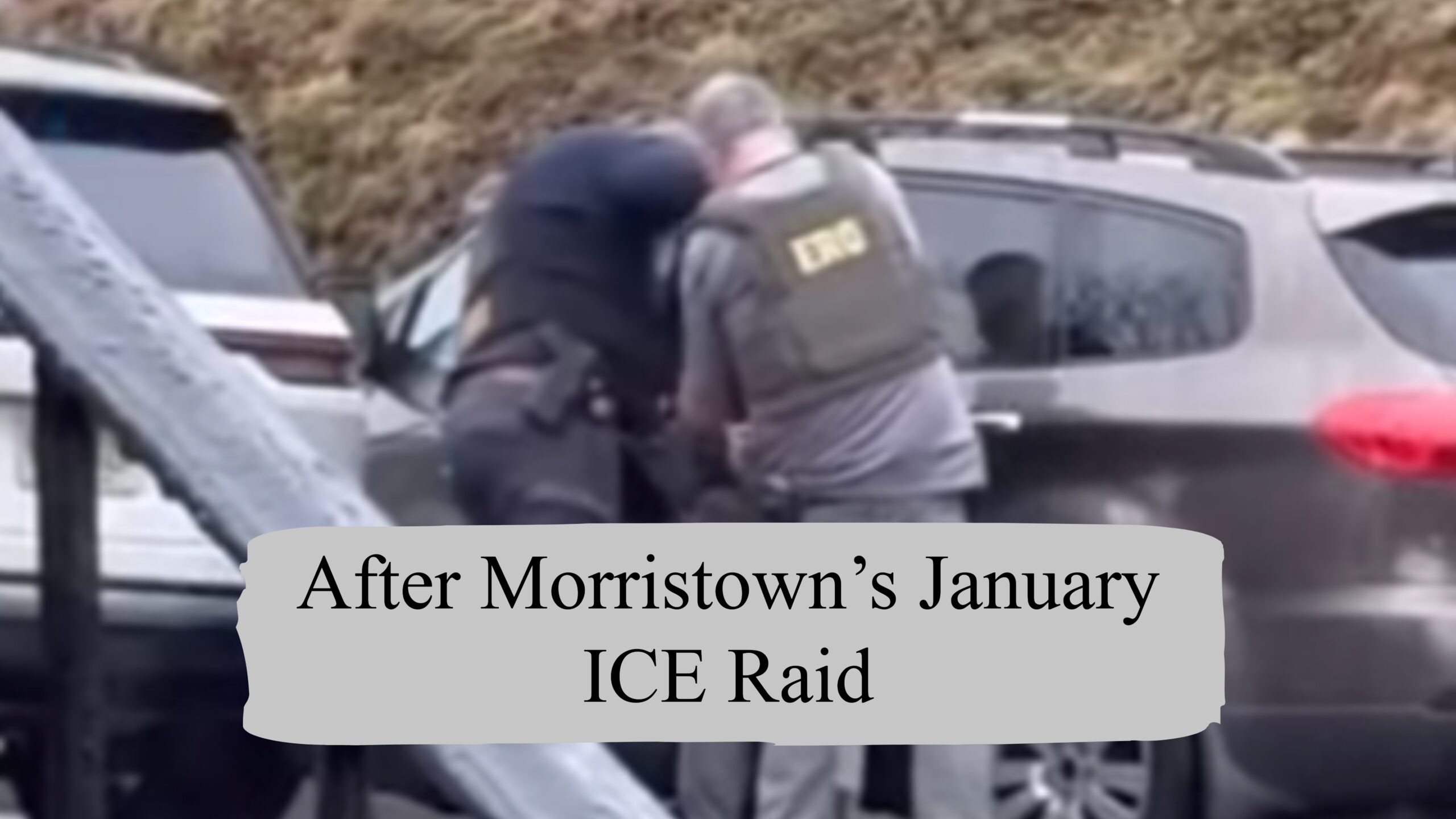
More than two months after federal agents detained 11 people near Speedwell Avenue, one teen’s release is documented, other detainees’ public status remains murky, schools say fear lingered for weeks, and residents now trade real-time warnings as they wait for answers.
MORRISTOWN, NJ – More than two months after a federal immigration operation in the Speedwell Avenue/Henry Street area of Morristown, the public record still offers only a partial picture of what happened to the 11 people detained that day. One Morristown High School student was released by court order within days. Another man’s family is still publicly fundraising for legal and household support. For the rest of the group, there have been few publicly documented updates beyond the federal government’s initial statement.
That uncertainty has become part of the story in Morristown. School officials have described a “chilling effect” on families, church and nonprofit networks have stepped in with food and legal support, and community-run social media channels now function as an informal real-time alert system when residents believe immigration enforcement may be happening again.
On Jan. 11, 2026, federal immigration agents conducted an operation in the Speedwell Avenue/Henry Street area, including a laundromat and nearby businesses, according to local reporting and statements from Morristown officials. Mayor Tim Dougherty said Morristown was not notified in advance and did not assist. DHS later said 11 people were arrested during what it called “routine immigration enforcement actions.” Earlier reporting established that all were either in removal proceedings or in the process of being removed, though federal authorities did not provide a full public accounting of each person’s identity or case status.
The clearest documented legal outcome remains the case of Juan Daniel Mendoza, a Morristown High School senior who was detained during the Jan. 11 operation and held at the Elizabeth Contract Detention Facility. He was released on Jan. 15, 2026, after U.S. District Judge Evelyn Padin ruled that he had been unlawfully detained and ordered his immediate release. The court also barred federal authorities from re-arresting him without showing that he posed a flight risk or danger. No re-arrest or additional ICE action against Mendoza has been publicly reported in the two months since.
The other named detainee whose case has remained publicly visible is Adonay Mancia Rodríguez, whose family says he was detained after stepping out to pick up food for his young daughter. As of the last confirmed public report, on Jan. 21, 2026, he remained in custody at the Elizabeth Contract Detention Facility and was able to receive family visits. Since then, no public update reviewed for this story has documented his release, transfer, or deportation outcome.
For the other nine detainees, the public record remains thin. No individual names, locations, releases, or confirmed deportations have been publicly documented in the local reporting and community updates reviewed for this article. In practical terms, that means the most complete public picture still consists of Mendoza’s release, the last confirmed Jan. 21 custody status for Mancia Rodríguez, and DHS’s initial statement about the group as a whole.
The legal and financial response has also been unevenly visible. Mendoza’s court fight produced a rapid, public result. His fundraiser was active in January, though the most recent research reviewed for this article found no visible recent organizer updates or current totals in public searches. Mancia Rodríguez’s fundraiser, organized by a relative, remained active as of March 24 at $30,879 raised toward a $35,000 goal from 710 donors. The page says the money is for attorney fees and family support. The same research found no new organizer posts or public comments on the page since its January launch.
An earlier report by the Daily Record said the community had raised about $120,000 combined across the two main campaigns by Jan. 21. Beyond those fundraisers, support has appeared to continue on a case-by-case basis through private attorneys, St. Margaret’s Church, and Mary’s Hands. Morristown Minute’s investigation did not identify any class-action lawsuit or broader group legal challenge tied to the Morristown detainees as a whole.
The most detailed public account of the longer-term community impact still comes from the Morris School District’s Feb. 4, 2026 virtual parent coffee, where Superintendent Anne Mucci said the raid had created a broader “chilling effect” and lingering “aftershocks” for families. Mucci said attendance dropped immediately after the operation, then later returned to the district’s normal 96 to 98 percent range. She also said some families were afraid to leave home for basic errands, contributing to food insecurity and strain across households.
The district responded by distributing more than 300 grocery bags, partnering with St. Margaret’s Church and Mary’s Hands for legal and paperwork help, and connecting families with services and support. No March-specific district statements were identified in our research, which means February remains the clearest on-record snapshot of how the raid affected students and families beyond the immediate arrests.
That leaves Morristown with a difficult information gap. The acute shock of January was covered. The quieter question, what daily life has looked like since, has been harder to track. Morristown Minute’s updated investigation found no reports of widespread new absenteeism or business closures in March. We did, however, find continued community vigilance, especially online, where residents share sightings, warnings, and updates about possible enforcement activity.
Those reports have included at least two recent, lower-profile incidents in Morristown that remain unconfirmed by Morristown Minute outlets or official statements. On March 23, posts on r/morriscountyICEnews, a related post in r/Morristown that was later deleted, and parallel local social media posts on threads and instagram, described unmarked vehicles, a white Jeep Grand Cherokee and gray Dodge minivan, outside the Morris County Courthouse, with at least one person allegedly taken into custody. On March 16, another community report described a single-person taken at 7 Ridgedale Avenue, again involving unmarked vehicles. Neither incident has been verified through public statements from ICE, DHS, Morristown, or Morris County, and neither matches the scale of the Jan. 11 operation. Still, both matter as examples of community-sourced transparency: residents circulating possible enforcement activity in real time because official confirmation often comes slowly, incompletely, or not at all.
That community-run transparency network has become its own local institution. Channels such as GoFundMe pages, r/morriscountyICEnews, and local social media now serve as the primary sources of real-time visibility on lingering effects and possible new activity after mainstream follow-up coverage largely tapered off in late January and early February. In other words, for many residents, official information and conventional news coverage have not fully answered the questions that remained after the raid.
The broader Morris County and New Jersey backdrop has kept those concerns alive. Morristown Minute has been reporting on protests and legal opposition tied to a ICE detention/processing facility in nearby Roxbury, a debate that has reinforced fears in some immigrant communities that federal immigration enforcement could expand its footprint in the region. That does not establish new raids in Morristown. It does help explain why even unverified reports of courthouse or street-level activity travel quickly through the town.
As of March 24, 2026, what is publicly established is narrower than what many families still want to know. The Jan. 11 operation happened. Morristown was not notified and did not assist. DHS said 11 people were arrested. Mendoza won release in federal court. Rodríguez was last publicly reported in custody on Jan. 21, and his family is still publicly fundraising for legal and household support. Schools say fear spread well beyond the directly affected families, even as attendance later rebounded. Reports of later ICE activity have continued to circulate through community channels, though the recent courthouse and Ridgedale Avenue incidents remain unverified. The biggest unanswered question, where the rest of the Jan. 11 detainees are now, remains difficult to answer precisely from the public record.
The next concrete updates, if they come, are likely to involve individual court developments, release notices, deportation outcomes, or new public statements from attorneys, family organizers, school officials, or federal authorities. Until then, the January raid remains not only a past event in Morristown, but an unresolved one.